Nikon 70-300mm f/4.5-5.6G AF-S VR Nikkor
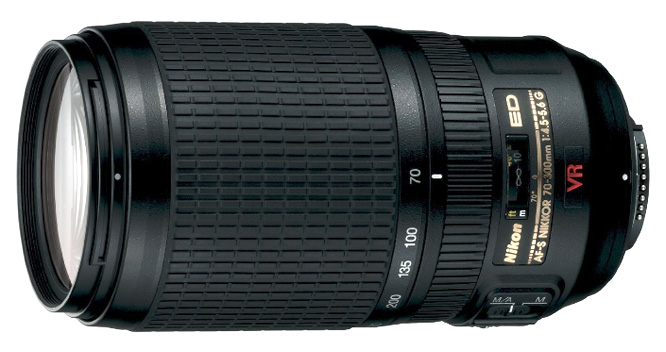
Nikon 70-300mm f/4.5-5.6G AF-S VR Nikkor Lens

This telephoto zoom lens costs around £440 and covers the popular 70-300mm range plus it sports Vibration reduction and a silent wave focusing motor.

Both Sigma and Tamron also produce 70-300mm lenses which include image stabilisation. Sigma's 70-300mm F/4-5.6 DG OS costs around £300, but lacks the silent focusing of the Nikon lens.

Tamron's SP 70-300mm f/4-5.6 sports a fast silent focusing motor and vibration correction and costs around £350.

Nikon 70-300mm f/4.5-5.6G AF-S VR Nikkor Handling and Features


Weighing 745grams, this lens is neither lightweight or overly heavy for a telephoto lens of this type and it balances well on the Nikon D700 used for testing. A large rubberised grip around the zoom ring dominates the exterior finish of the lens and provides plenty of space to hold the lens securely.

Build quality is good for a lens at this price point. The exterior of the lens barrel is mostly made of high quality plastics, and although it isn’t weather sealed, it has a rubber gasket around the lens mount to prevent to ingress of dust and moisture.

The lens takes 67mm filters, which is an uncommon size for Nikon lenses. This may mean a stepping ring will have to be used to enable filters from other lenses to fitted. As focus is performed internally, the filter thread does not rotate, which makes this lens ideal for use with polarising and graduated filters.

Nikon promise that the Vibration reduction system this lens is equipped with will allow sharp shots to be taken hand held at shutter speeds up to four stops slower than would be possible without aid. With this system enabled, I am able to take acceptably sharp hand held shots about half the time at 1/40sec, which is just a little faster than the four stops quoted by Nikon. Increasing the shutter speed to 1/60sec greatly improves my chances of achieving a sharp shot, with almost every shot being absent of camera shake.

Nikon 70-300mm f/4.5-5.6G AF-S VR Nikkor Performance


As is often the case with high ratio zooms, this lens starts off very sharp at 70mm. In fact the sharpness is excellent in the centre and very good towards the edges when shooting wide open.

Peak quality across the frame is achieved between f/5.6 and f/8 where sharpness is also excellent in the centre and very good towards the edges.

With the lens zoomed to 135mm the excellent sharpness in the centre is maintained at maximum aperture, but the quality towards the edges drops to fairly good levels. Stopping the lens down improves the clarity towards the edges, but it doesn't reach good levels until f/11.

At 300mm sharpness decreases somewhat and is only fairly good in the centre at f/5.6, and fair towards the edges. As the lens is stopped down, sharpness increases until f/11, where the clarity achieved is very good in the centre and good towards the edges.

70mm 135mm
300mm

How to read our graphs

The blue column represents readings from the centre of the picture frame at the various apertures and the green is from the edges. Averaging them out gives the red weighted column.

The scale on the left side is an indication of actual image resolution. The taller the column, the better the lens performance. Simple.

For this review, the lens was tested on a Nikon D700 using Imatest.

At shorter focal lengths, chromatic aberrations are well controlled and won't pose an issue, even at large print sizes. However, at 300mm, levels of fringing towards the edges of the frame exceeds three pixel widths in size, which may be visible along high contrast edges.

70mm 135mm
300mm

How to read our graphs

Chromatic aberration is the lens' inability to focus on the sensor or film all colours of visible light at the same point. Severe chromatic aberration gives a noticeable fringing or a halo effect around sharp edges within the picture. It can be cured in software.

Apochromatic lenses have special lens elements (aspheric, extra-low dispersion etc) to minimize the problem, hence they usually cost more.

For this review, the lens was tested on a Nikon D700 using Imatest.
Falloff of illumination is well controlled throughout the zoom range. At 70mm the corners are 1.06 stops darker than the image centre and at 300mm the corners are still only 1.11 stop darker. Visually uniform illumination is achieved at f/8 throughout the zoom range.

2.37% barrel distortion is present at 70mm and 1.53% pincushion distortion at 300mm. For most applications, these mild levels of distortion won't pose any issues. It will only become apparent where there are straight lines parallel to the edges of the frame. If perfectly straight lines are paramount, the distortion should be simple enough to correct in image editing software afterwards as the distortion pattern is uniform across the frame.

A deep circular hood comes supplied with the lens, which does an excellent job of shielding the optics from extraneous light that may cause flare or loss of contrast. When shooting directly at a strong light source, this lens can be prone to a reduction of contrast, so care may need to be taken in those circumstances.


Wideangle - ISO200, 1/1000, f/8, 70mm Telephoto - ISO200, 1/1000, f/8, 300mm
Sharpness at 300mm is good when the lens is stopped down - ISO500, 1/500, f/8, 300mm At shorter focal lengths, sharpness is good at all apertures, especially in the centre - ISO900, 1/250, f/8, 165mm
ISO720, 1/250, f/11, 300mm ISO640, 1/250, f/8, 122mm
ISO500, 1/250, f/9, 300mm ISO3600, 1/250, f/5.6, 300mm

Nikon 70-300mm f/4.5-5.6G AF-S VR Nikkor Verdict


This lens performs well throughout the zoom range, especially at shorter focal lengths in the centre of the frame. At 300mm stopping down the lens a little will produce the best results. With a price tag of £440 this lens represents good value, due to its good sharpness, build quality and the useful Vibration Reduction feature.
The Nikon 70-300mm VR lens represents good value, due to its good sharpness, build quality and the useful Vibration Reduction feature.

Nikon 70-300mm f/4.5-5.6G AF-S VR Nikkor Pros

Excellent sharpness in the centre between 70mm and 135mm
Good build quality
Vibration Reduction

Nikon 70-300mm f/4.5-5.6G AF-S VR Nikkor Cons

Chromatic aberrations towards the edges at 300mm
Reduction in sharpness at 300mm and f/5.6

FEATURES
HANDLING
PERFORMANCE
VALUE FOR MONEY
OVERALL


Nikon 70-300mm f/4.5-5.6G AF-S VR Nikkor Specification

Price £440
Contact www.nikon.co.uk
Filter size 67mm
Format Full-frame
Construction 17 elements in 12 groups
Angle-of-view 34°20'
35mm equivalent focal length (on APS-C body) 105mm-450mm
Internal focusing Yes
Image stabilisation Yes
Minimum focus 1.5m
Maximum aperture f/4.5-5.6
Minimum aperture f/32-40
Weight 745g
Size (lxw) 80 x 143.5mm
In the box Lens hood, soft case

Add your message

Login required
Please login here or if you've not registered, you can register here. Registering is safe, quick and free.

photodo Stats

1102 lenses
428 MTF tests
74 in-depth        photodo reviews
100+ users join each day

Help the lens community by reviewing or rating a lens today via our lens search