Canon 135mm F/2 L USM
Canon claims this lens as the fastest 135mm prime lens and we can’t find a faster one available. So what use is a fast, short telephoto lens. We take a look.
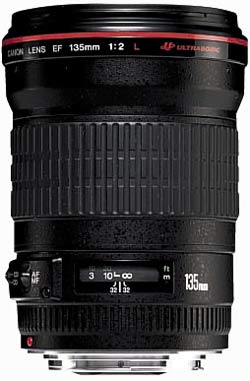 Specification
- Focal length 135mm
- Aperture f/2.0
- Angle of view
- Filter size / type 72mm
- Construction Elements/groups 10 elements in 8 groups
- Focusing type Internal
- Closest focus 0.9m
- Weight 0.750kg
- Dimensions (Dia x length) 82.5x112mm
- Mounts available Canon,
- Tripod bush No
- Price £900
Build and handling
As with all of Canons L series lenses, this one is built for professional use and will stand a fair bit of miss handling. The simple design of the prime lens helps with the single focus ring and a pair of small switches for AF/MF and focus limit being the only moving parts on the lens, a standard distance window, with a basic depth-of-field scale being the only other accoutrement.
The focus limit switch restricts focusing to 1.6m to infinity from the full 0.9m to infinity and cuts down the short focus time even more. It also helps if you are not doing any close work or are trying to shoot through a fence or the like. The USM motor keeps things nice and quiet as well as quick. Internal operation means the front element does not rotate, another plus point.
The focus ring doesn’t rotate during autofocus either, but can be manually over-ridden without switching. So generally, it is a very usable lens. The focal length is at the long end of what is normally recommended for portraiture and with the perspective it gives, this still holds true in the cropped digital age. The wide aperture does mean that this lens can be used in low lighting conditions where others might well struggle. This includes indoor sports in confined conditions as well as Gig and stage photography.
Optical Quality
L glass from the Canon camp is legendary in its reputation for producing the goods and this example is no black sheep. The simpler construction of prime lenses does make high quality easier to obtain, but even so, this is a top quality piece of glass in all respects.
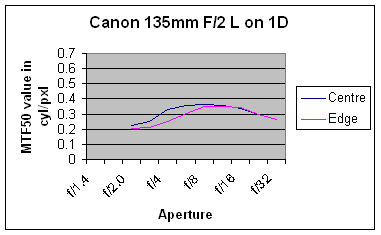
Contrast, as is usual, is good and the control of chromatic aberrations is well handled. Sharpness wide open is certainly usable and improves as the lens is stopped down, peaking at around the f/8 mark.
Where this lens does score is in the out-of-focus areas, giving a pleasing effect that helps the main subject stand out.
 A useful focal length for close quarter sport action, the fast aperture makes this lens just as effective indoors. |  Even with a cluttered background, the depth of field helps this grabbed portrait shot jump out in the full size file. |
 |
|
Click on each comparision photo below to view full size versions
 135mm at f/2 |  135mm at f/8 |
Below is our lens test data. To find out how to use these graphs look at this article: How we test lenses
Verdict
A lens of this nature is a reasonably specialised piece of kit. It’s speed, both light gathering and focussing, make it ideal for indoor sport and event work. It also scores highly if you want portraits with OOF backgrounds where the focal length is near perfect.
So if you have the need for a lens of this type and can warrant the price, you will not be disappointed with the results.
In summary the main positive points of the Canon 135mm F/2 L USM are:
 Fast and silent Autofocus
Simple operation
Good optical quality with nice OOF ‘Bokeh’
Negative points are:
 Price
Price
Unusual size filters.
Check the latest price of the Canon 135mm F/2 L USM here
Test performed by Ian Andrews of www.wildaboutkent.co.uk
I honestly don't understand the conclusions of this review. However there is whispering of late that Canon has had some quality control issues. There may be an unusually large sample variation.
But for Digital 1.6x crop size.
The image size is seem narrow to shoot more than single or couple people.
If by fast, you mean bright (widest available aperture) in a 135mm lens, see this Autofocus lens in Maxxum/Dynax/Alpha mount.
Sony Carl Zeiss® Sonnar® T* 135mm f/1.8
http://www.photodo.com/product_1127.html
Results? Well, just one simple word defines these - FANTASTIC!
Sharpness is amazing even from full aperture with edges and corners following suit on stopping down to f2.8 when it remains in exceptional levels of sharpness until diffraction begins to take it's toll on sharpness, initially corners/edges only at f22 and then in the centre at f32.
This lens performs just as amazingly on APS-C sized sensor cameras when it effectively behaves like a 216mm f/2 prime lens (think how much such a full-frame lens would cost?!) and also produces still stunning quality when used with my SIGMA EX DG 1.4x converter, effectively providing a 302mm f/2.8 lens, losing virtually nothing in quality until stopped down to and effective f/32 and f/45 when diffraction spoils things a little.
I don't know what other converters are like, except that in a recent magazine comparison test, the SIGMA converters (both 1.4x and 2x) appeared to be significantly better than any of the others tested, including Canon's own! I know that my 1.4x SIGMA converter produces stunning results when used with the Canon 135mm f/2L USM lens. This is more applicable to use on APS-C cameras due to the smaller sensor using the central sweet spot of the image circle.
A surprisingly versatile and ultra high quality option for those like me, who work with both FF and APS-C sized sensor cameras.
David Chamberlain
Quote DaveCham: "This lens performs just as amazingly on APS-C sized sensor cameras when it effectively behaves like a 216mm f/2 prime lens"
This is not really the case, the 135 mm F2.0 will still behave as a 135 mm, the only thing that will hapen is a crop. You will lose a little of it's small DOF, because you also have to consider that F2.0 becomes F2.0 * 1.6 = F3.2. With other words, a full frame will give you the exact same picture by F3.2, only with a larger surrounding.
A 216 mm will behave totally different.
Let you know my experience.
Leo Jonkers
Add your message
Please login here or if you've not registered, you can register here. Registering is safe, quick and free.
photodo Stats
428 MTF tests
74 in-depth photodo reviews
100+ users join each day
Help the lens community by reviewing or rating a lens today via our lens search

Latest Lens Reviews
- Chinon 28mm f/2.8 Vintage Lens Review
- Canon EF 70-200mm f/4L IS II USM Lens Review
- Samyang AF 85mm f/1.4 EF Review
- Sigma 70mm f/2.8 DG Macro Art Review
- Samyang AF 24mm f/2.8 FE Review
- Meike 50mm f/1.7 Review
- Tamron 70-210mm f/4 Di VC USD Review
- Lensbaby Burnside 35mm f/2.8 Review
- Asahi Super Takumar 50mm f/1.4 Review
- Asahi Super-Multi-Coated Takumar 135mm f/3.5 Review