Sigma 10-20mm f/4-5.6 EX DC
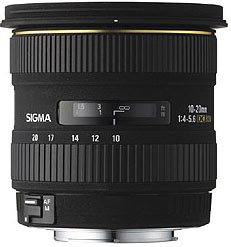 Specification
- Focal length 10-20mm
- Aperture f/4-5.6
- Angle of view 102.4-63.8°
- Filter size/type 77mm
- Construction Elements/groups 14 elements in 10 groups
- Focusing type Internal HSM
- Closest focus 0.24m
- Weight 0.470kg
- Dimensions (Dia x length) 83.5x81mm
- Mounts available Sigma, Canon, Nikon(D)
- Tripod bush No
- Price (SRP) £369.99
Build and handling
This lens is designated to, and joins Sigma’s EX range. It therefore comes with the three year UK warranty and is shipped with a lens hood in a zip-topped pouch of the type that now sports a belt loop. The finish is the hardy matt black that we've praised before. Canon and Sigma mounts sport the usual AF/MF switch while the Nikon hasn't. Both are straight in front of the mount. The remainder of the barrel is split approximately into thirds, the first and last third being occupied by zoom ring and focus ring. The zoom ring is marked at 10, 12,14, 17 and 20mm. Zooming extends the lens length by barely 5mm, so a zoom lock would be fairly superfluous!
Focus is achieved with a silent HSM motor, which does not have to move the elements very far, and therefore is almost instant. The front element does not rotate during use, making filters easy to use.
Sigma have done a good job here, with the lens sporting a 77mm filter thread, not a huge size for an optic this wide. And the front element does not protrude, so that close fitting filters can be used.
We tried a Cokin Z-Pro system on the lens and found that, fitted normally, there was no vignetting if the holder was oriented in the same way as the hood is fitted. However, it did vignette at 10mm with the holder in a normal position when taking landscape shots. (Disappears between 11 and 12mm) With the holder reversed, leaving just the single slot, this problem was overcome. Sigma does state in their multi-language leaflet that only one filter should be used and thicker ones ‘may’ cause vignetting.
Optical Performance
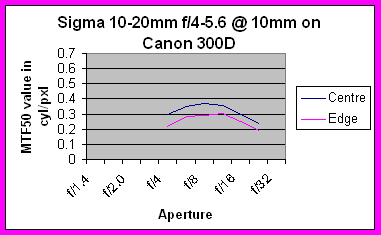
This lens is sharp! At 20mm, resolution tests showed it matched, and at one point even slightly out performed the venerable Canon 17-40mm L.
At 15mm it's a little soft at the edges, although still nice in the centre, but by the time it gets down to the 10mm mark the edges have improved again. In fact, at the wide end, the overall performance was the best in the range. The lens has obviously been optimised for the shorter focal length as there was no distortion there, whereas the 20mm end did have a little pin-cushioning.
Chromatic aberrations have been very well controlled with the employment of three SLD (Special Low Dispersion) elements, one moulded aspherical and two hybrid aspherical elements. Although not completely eliminated, they did not show up significantly.
The lens is designated as a DC, meaning that it's designed exclusively for dSLR cameras with a crop factor of 1.5x or greater. However, we did try it on a Canon 1D, which has a crop factor of 1.3x and found that, without filters, it could be used from 11mm upwards without vignetting.
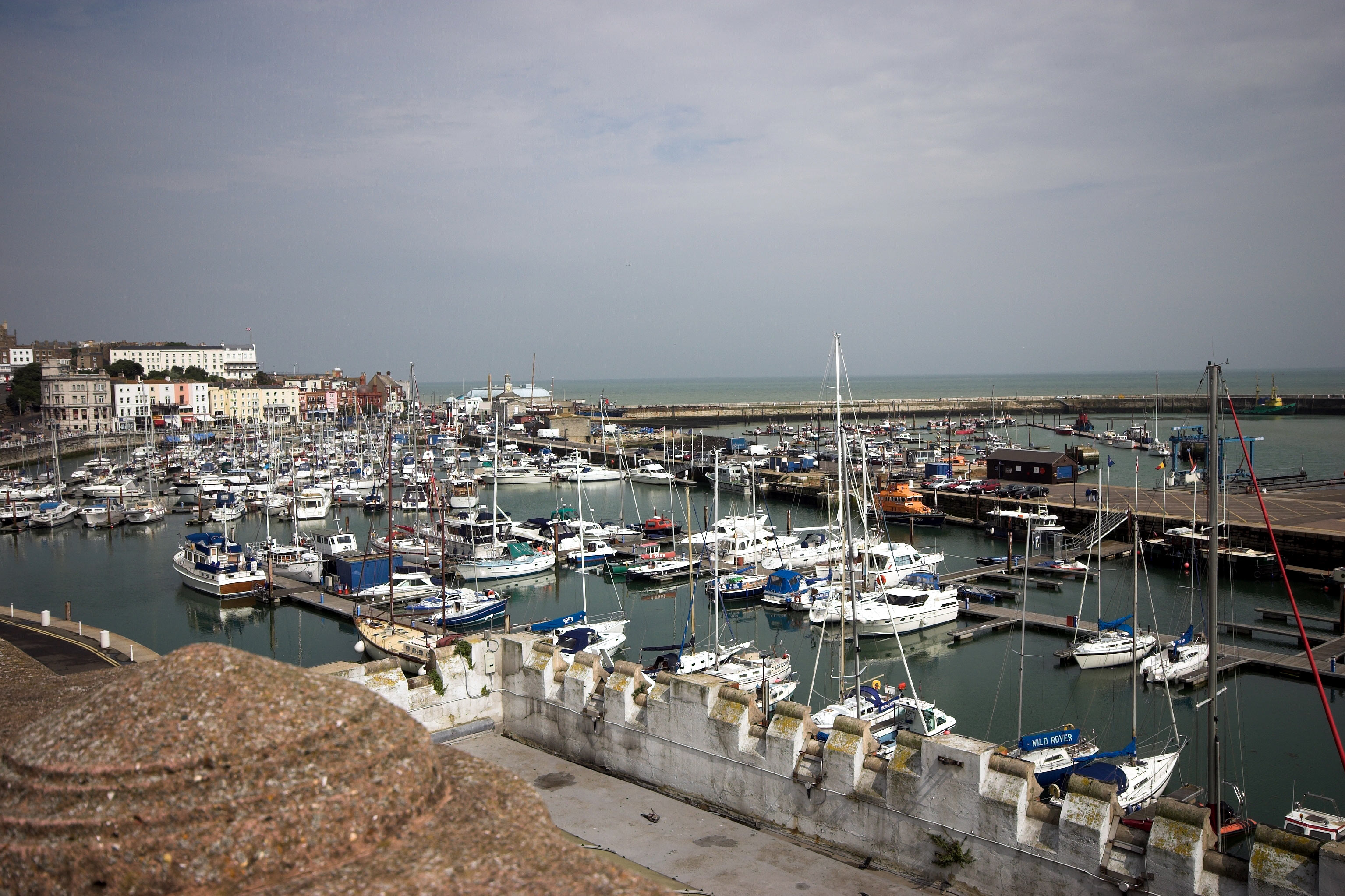
| 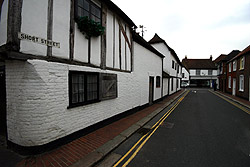 This shot would have been impossible without the width, enabling the street sign to be included. Canon 300D, 10mm, 1/640sec at f/11 |
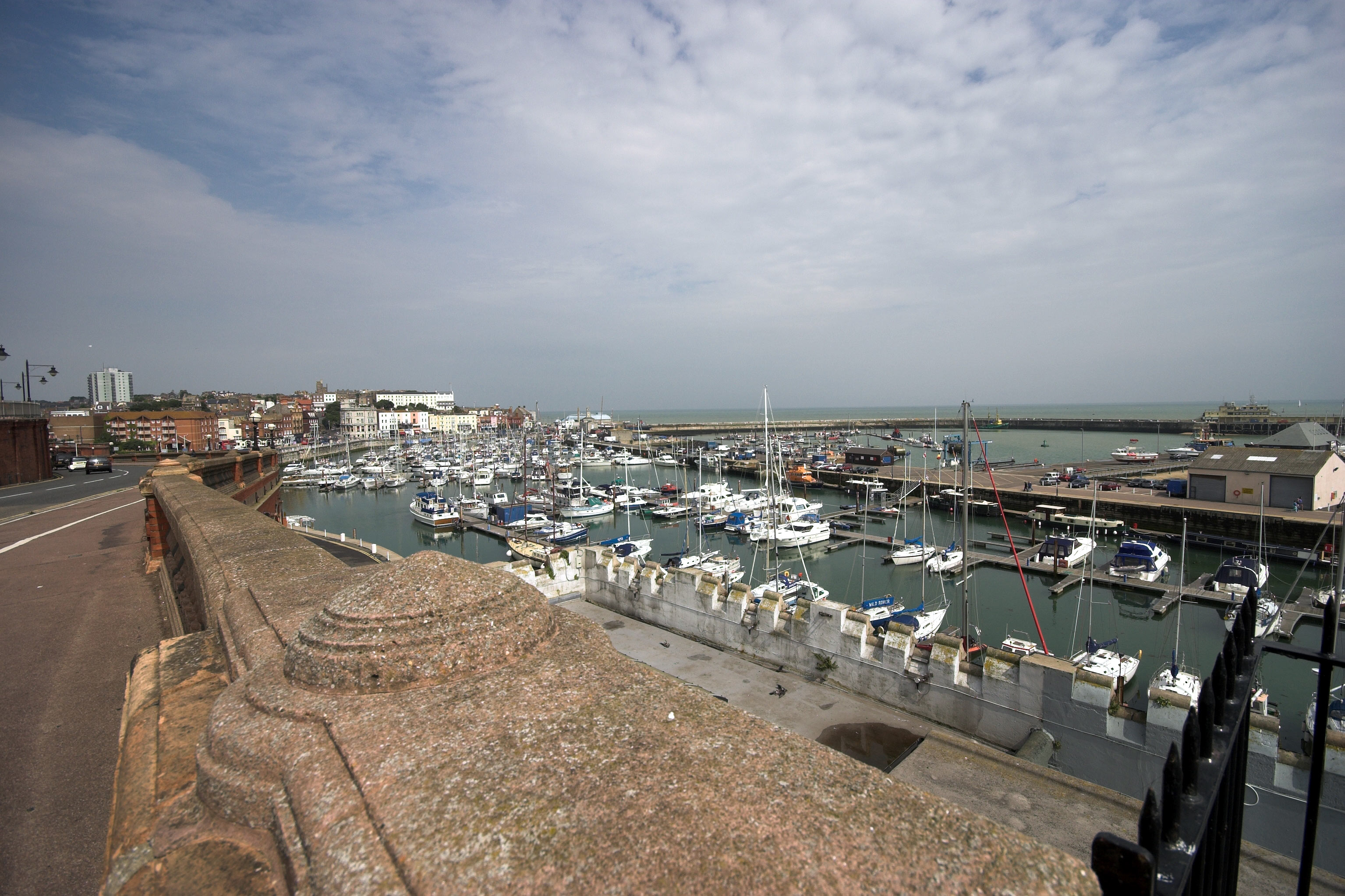
Right: Taken just a few paces away from the last shot, perspective is a subject all of its own! EOS 1D, 1/10sec @ f/11. 10mm |
|

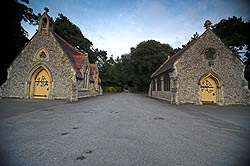
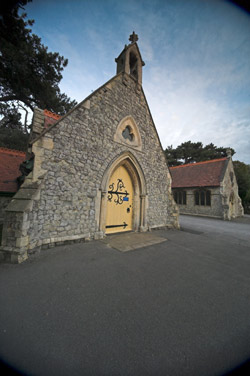
Click on each comparision photo below to view full size versions
|  10-20mm set at 20mm and f/8 |
 10-20mm set at 10mm and f/8 |  10-20mm set at 20mm and f/5.6 |
Below is our lens test data. To find out how to use these graphs look at this article: How we test lenses
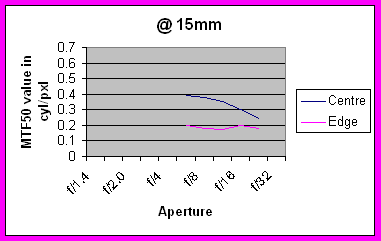
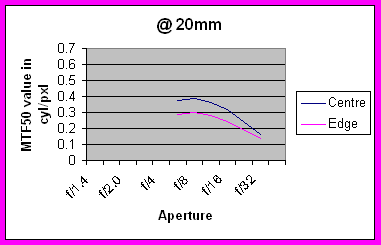
For comparison, the Canon 17-40mm f/4 L at 20mm on the same camera.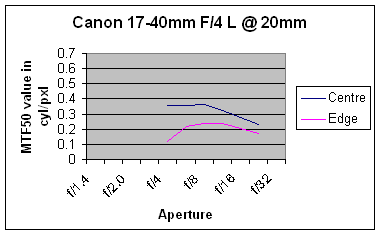
Verdict
With the wide field of view that this lens gives the digital SLR owners that require panoramic style angles, this lens is an answer to their prayers. The performance is excellent and the size and weight is little more than a standard zoom. Aimed at an area where there are no contenders stepping down from the 35mm arena and fulfilling a definite need, Sigma should be onto a winner here.
In summary the main positive points of the Sigma 10-20mm f/4-5.6 EX DC are:
 Good performance, nudging excellent at the wide end.
Ability to use standard filters
Weight, size and handling
Price
Negative points are:
 Softish edges in middle of range.
Slight pincushion at 20mm end.
Check the latest price of the Sigma 10-20mm f/4-5.6 EX DC here
Test by Ian Andrews www.wildaboutkent.co.uk
Although performance in the vast majority of the central area was very good, the same couldn't be said for the edges and corners which were really quite poor, in my opinion.
Distortion at or near horizontal edges and in particular, the corners was extreme. Absolutely awful in my opinion.
I have since disposed of this lens and purchased a Canon EF-S 10-22mm f/3.5-f/4.5 USM which is in a different class it has to be said. If you use Canon, save up and buy the 'real thing' is my advice.
David Chamberlain
Add your message
Please login here or if you've not registered, you can register here. Registering is safe, quick and free.
photodo Stats
428 MTF tests
74 in-depth photodo reviews
100+ users join each day
Help the lens community by reviewing or rating a lens today via our lens search

Latest Lens Reviews
- Chinon 28mm f/2.8 Vintage Lens Review
- Canon EF 70-200mm f/4L IS II USM Lens Review
- Samyang AF 85mm f/1.4 EF Review
- Sigma 70mm f/2.8 DG Macro Art Review
- Samyang AF 24mm f/2.8 FE Review
- Meike 50mm f/1.7 Review
- Tamron 70-210mm f/4 Di VC USD Review
- Lensbaby Burnside 35mm f/2.8 Review
- Asahi Super Takumar 50mm f/1.4 Review
- Asahi Super-Multi-Coated Takumar 135mm f/3.5 Review